KB, Shinhan and Samsung Life Accelerate Expansion of Care Businesses, Prioritizing Market Capture Over Near-Term Profit
Source: ChosunBiz (Japanese edition) | Published: June 13, 2026 | Updated: June 15, 2026
As South Korea enters a super-aged society, insurers are rapidly scaling up their nursing care facility operations. With declining birth rates and aging population slowing growth in their core insurance businesses, companies are expanding into nursing and care services. However, because large upfront investments are required, the current focus is on capturing market share rather than securing immediate returns.
According to industry sources on June 13, among insurers, KB Life is the most aggressive in expanding its care business. Its subsidiary KB Golden Life Care currently operates five city-center nursing facilities in the Seoul metropolitan area—Seocho, Wirye, Eunpyeong, Gwacheon, and Gangdong-south—and plans to build another in Seoul’s Songpa District by 2028.
Monthly fees run around KRW 3.74 million for a single room—far from cheap—yet most facilities are already at full occupancy. The company also operates one silver town (Pyeongchang-dong, Seoul) and four day-care centers (Gwacheon, Eunpyeong, Gangdong, Wirye).
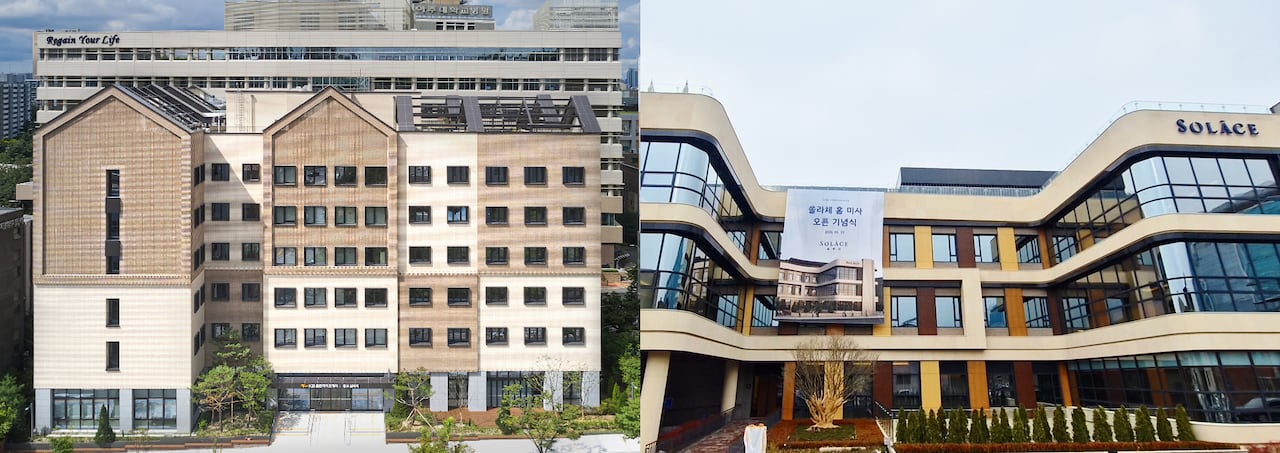
(Image: KB Golden Life Gwanggyo Village and Shinhan Life SOLACE HOME MISA panorama, provided by respective companies)
Late entrant Shinhan Life established its dedicated senior-care subsidiary “Shinhan Life Care” in 2024 and opened its first care facility, “SOLACE HOME MISA,” in Hanam, Gyeonggi Province this January. Monthly fees are around KRW 4.8 million for a single room. The company has already secured land in Haeundae (Busan), Eunpyeong and Wirye (Seoul) for additional facilities. Shinhan Life Care also operates a day-care center in Bundang.
Samsung Life is also exploring expansion of its care business. Through its subsidiary “Samsung Noble County,” it operates the senior residence “Noble County,” providing both housing and care services. Noble County, built in 2001 in Yongin, Gyeonggi Province, was Korea’s first silver town.
For a dedicated 60 m² unit, the deposit ranges from KRW 700 million to KRW 800 million, with monthly living costs exceeding KRW 3 million—yet demand for popular layouts keeps a long waiting list. Samsung Life plans to launch its insurance-linked healthcare elderly care business as a new revenue model as soon as possible.
According to the Korea Statistical Information Service, last year the share of the population aged 65 and over exceeded 20%, and long-term care demand is growing rapidly. Insurers’ ability to keep providing health management, care and housing services after a client buys a policy—thereby expanding customer touchpoints—is seen as a key advantage.
However, profitability is currently weak. Building care facilities requires land purchases, and facility construction and hiring professional staff also incur costs; most players have yet to escape losses.
KB Golden Life Care, the largest player in the industry, posted a net loss of KRW 10.4 billion last year, while Shinhan Life Care recorded a net loss of KRW 1.2 billion. An industry insider said: “The current focus is on capturing market share and accumulating operational experience, not returns,” adding that “recovering the investment will take a considerable amount of time.”
发布者:猫头鹰养老,转载请注明出处:https://www.seniorhousing.cn/en/korea-insurers-eldercare-kb-shinhan-samsung-2026-en/